Afterword
The Crucible for the Human Soul
From the dark and bloody ground of the frontier to the elegant drawing rooms of occupied Philadelphia, the American Revolution was more than a war of maps and muskets—it was a crucible for the human soul.
While the characters of Ethan Montgomery and Maddie Graves in The Devil Take Tomorrow are products of the imagination, the world they inhabited was a powder keg of very real shifting loyalties and shadows. In 1777 and 1778, the City of Philadelphia was a place of dangerous contradictions—a capital occupied by the British Empire, where a single whispered word or a stolen letter could change the course of the American Revolution.
The Intelligence War
The methods Ethan used to infiltrate the British high command—the use of invisible inks (often referred to as “sympathetic stain” or “white ink”), coded letters, and the exploitation of social circles—were the hallmarks of George Washington’s sophisticated intelligence network. Washington was, in many ways, America’s first great spymaster. He understood that one man in the right place could indeed be worth more than a regiment.
The Realities of Valley Forge
The winter of suffering at Valley Forge was not merely a battle against the elements, but a race against medical ignorance. The Yellow Springs Hospital, where Ethan bids farewell to Captain Fraser, was a groundbreaking institution. Under the guidance of Dr. Bodo Otto, it represented a turning point in the Continental Army's attempt to professionalize military medicine. The description of putrefaction and the failure of bloodletting are, unfortunately, historically accurate reflections of the era’s limitations. As Ethan learned at the bedside of Captain Fraser, every victory carried a staggering human price.
The Battle of Monmouth
The engagement at Monmouth Courthouse on June 28, 1778, was a literal and figurative trial by fire. It was the longest one-day battle of the war, and the first time the Continental Army—newly trained by Baron von Steuben—stood toe-to-toe with British Grenadiers in a formal line of battle and held the field. The record-breaking heat of that day—which claimed many lives through exhaustion—is a central fact of the engagement that Ethan navigated as he stepped out of the shadows and back into “the lines.”
A Note on the Fate of Spies
In the 18th century, the Laws of Nations were clear: a soldier in uniform was a prisoner of war, but a man in a “disguised habit” behind enemy lines was a spy. The penalty for spying was almost universally death by hanging. The “Certainty of Justice” faced by the Parker Trio reflects the grim stakes of the era, where men like Nathan Hale and John André paid the ultimate price for the “crucial service” Ethan managed to survive.
Ultimately, The Devil Take Tomorrow is a story about the cost of that service—the way war forces good people to commit “necessary sins” to secure a future for the next generation and the right to live a life of one's own making.
A Tribute to the Ladies: From the Parlor to the Picket Line
Bravery took many forms in revolutionary America. History often focuses on the “Great Men” and the movements of armies, but The Devil Take Tomorrow is equally a story about the resilience and raw courage of the women who endured the encroachment of those armies. Women like Maddie and Agnes Graves faced a unique kind of peril in the shadows, acting as couriers, scouts, and the emotional anchors for men who were “beat all to hell and back.” Patriot women provided not only supplies for a fledgling army in need of everything, but also held together their households, farms, and businesses in the face of shortages, raiding parties, and the forced occupation of their homes and hearths.
History also found fierce, uncompromising heroes in women like the Beltrams. Grandmother Beltram represents the indomitable matriarchs of the frontier—women who, like the “tomahawk-wielding” protector of the cause, were more than a match for the bottled-up arrogance of men like Sinclair. Alice Beltram’s choice to dress like a man to fight for her beliefs reflects the stories of documented historical women like Deborah Sampson or Anna Maria Lane, who donned the hunting shirt and took up the musket because their convictions outweighed the constraints of their gender and the risk of severe legal consequences for their fraudulent enlistments.
Whether they were fighting in the lines, guarding notorious prisoners in their cellars, or rebuilding a “River Haven” from the ruins of abandonment, these women refused to be victims. They were both the invisible warriors and the soul of the home front during the American Revolution, and the architects of the peace that followed.
The “Law of Immense Satisfaction”
As Ethan and Maddie find their “River Haven” on the banks of the Hudson, looking toward an uncertain tomorrow, they represent the thousands of individuals who “fell forward” until the war was won. In their characters, we are reminded that for every name recorded in the history books, countless others were working in silence, whose only reward for the necessary risks and sins committed in the shadows was the independence—and the freedoms—we now enjoy.
Philadelphia in 1776
At the outbreak of the American War of Independence, Philadelphia was the largest English-speaking city in the world after London, boasting a population of some 40,000. Its picturesque cobblestone streets, laid out at right angles, expanded westward from extensive wharves along the Delaware River.
The cultural jewel of the Thirteen Colonies, Philadelphia's list of firsts in 18th-Century America impresses. These include the first public school, lending library, hospital, medical society, medical college, scientific institution, fire engine, volunteer fire company, lightning rod used for protection against fires, fire insurance company, first bell ever cast in America, first permanent theater house and company of stage players, first anti-slavery society, and the first treatise against slavery published in any part of the world.
During the war for independence, the city became a military objective of Major General William Howe, commander in chief of the British army in America. In the fall of 1777, at great cost to his army, Howe succeeded in capturing the seat of the rebel government. Benjamin Franklin, then on a diplomatic mission in Paris, took the news of Howe's victory in stride. His shrewd assessment has amused historians for centuries: “Sir, you mistake the matter. Howe hasn't taken Philadelphia; Philadelphia has taken Howe.”
Franklin was right. Howe occupied Philadelphia for the next nine months, spending much of that time in liquor-soaked indolence while General George Washington and his officers transformed the Continental Army at Valley Forge into an effective, disciplined fighting force.
Independence Hall
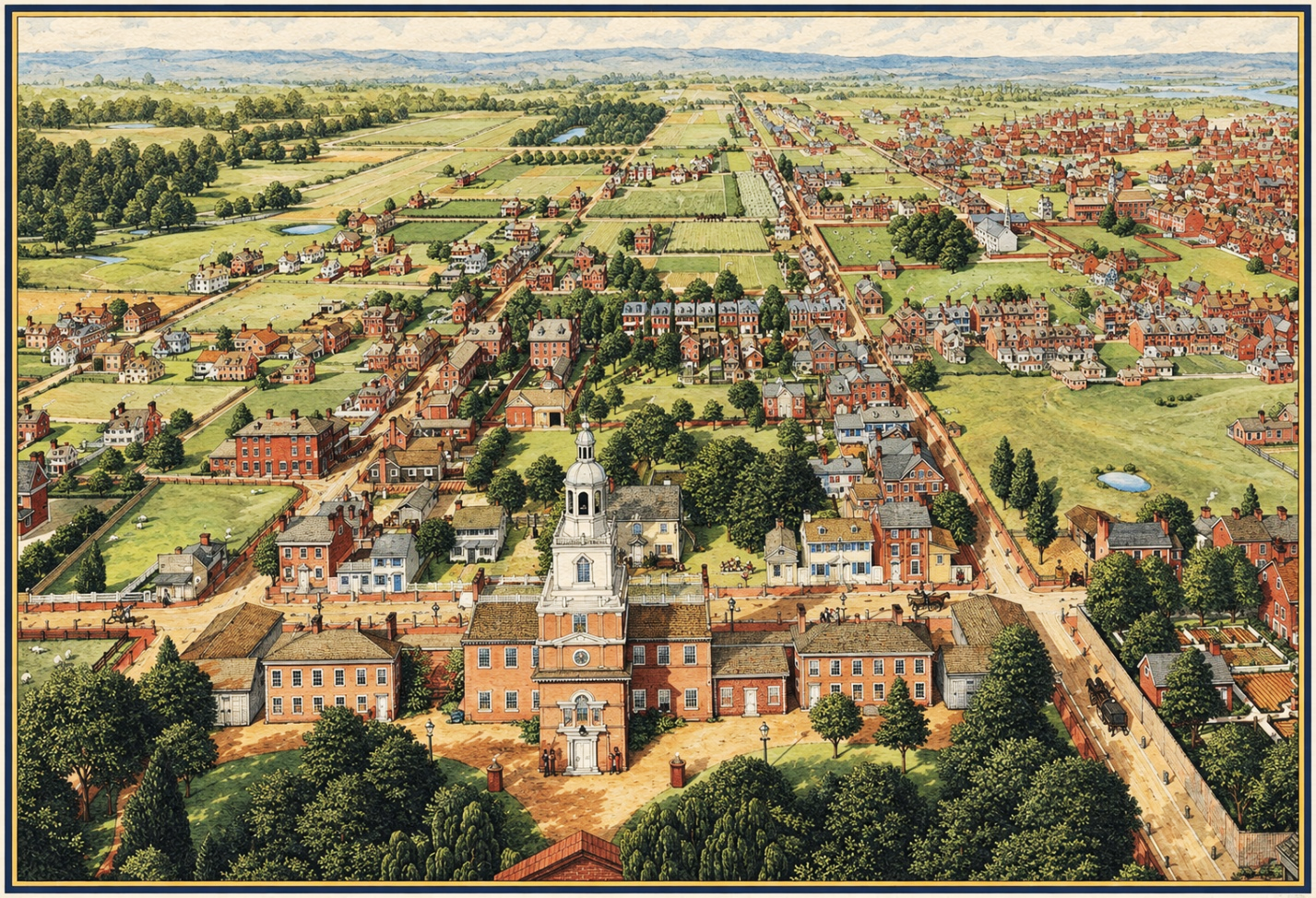
The Pennsylvania State House fronted on Chestnut Street between Fifth and Sixth streets. Known today as Independence Hall, this revered building was the seat of the rebel Congress through most of the American Revolution. The painting below by Philadelphia artist Paul MacWilliams, Pennsylvania State House in 1776, depicts a bird's-eye view from behind the State House looking north toward the highlands. Based on years of meticulous research, MacWilliams’ splendid rendering captures the life and landscape of the revolutionary city.
The Easburn Map
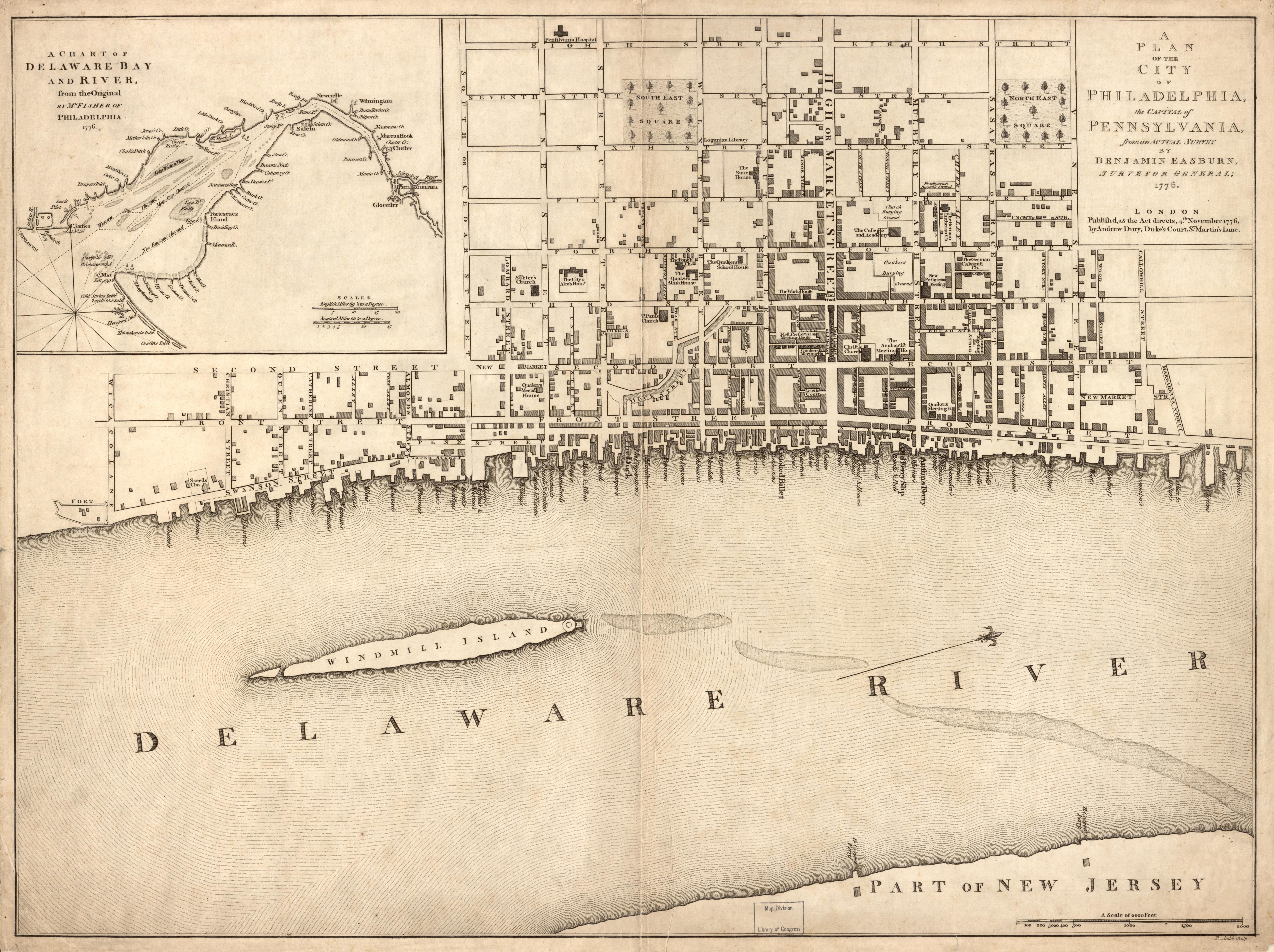
The Philadelphia street map presented here is part of a survey performed in 1776 by Benjamin Easburn, surveyor general of Pennsylvania. Oriented with the north toward the right, the map shows wharves, streets, houses, parks and cemeteries, as well as a library, college, jail, almshouse and hospital. It also indicates the locations of churches of a variety of denominations, including Roman Catholic, Lutheran, German Calvinist, Presbyterian, Moravian, and a Swedish church, along with several meeting houses and other institutions associated with the predominantly Quaker community.
The Faden Map
The map below was published in London in 1777 by William Faden. The dark shading outlines Philadelphia proper along the Delaware River waterfront. The lighter shading indicates the anticipated city expansion across a two-mile grid between the Delaware and Schuylkill rivers.
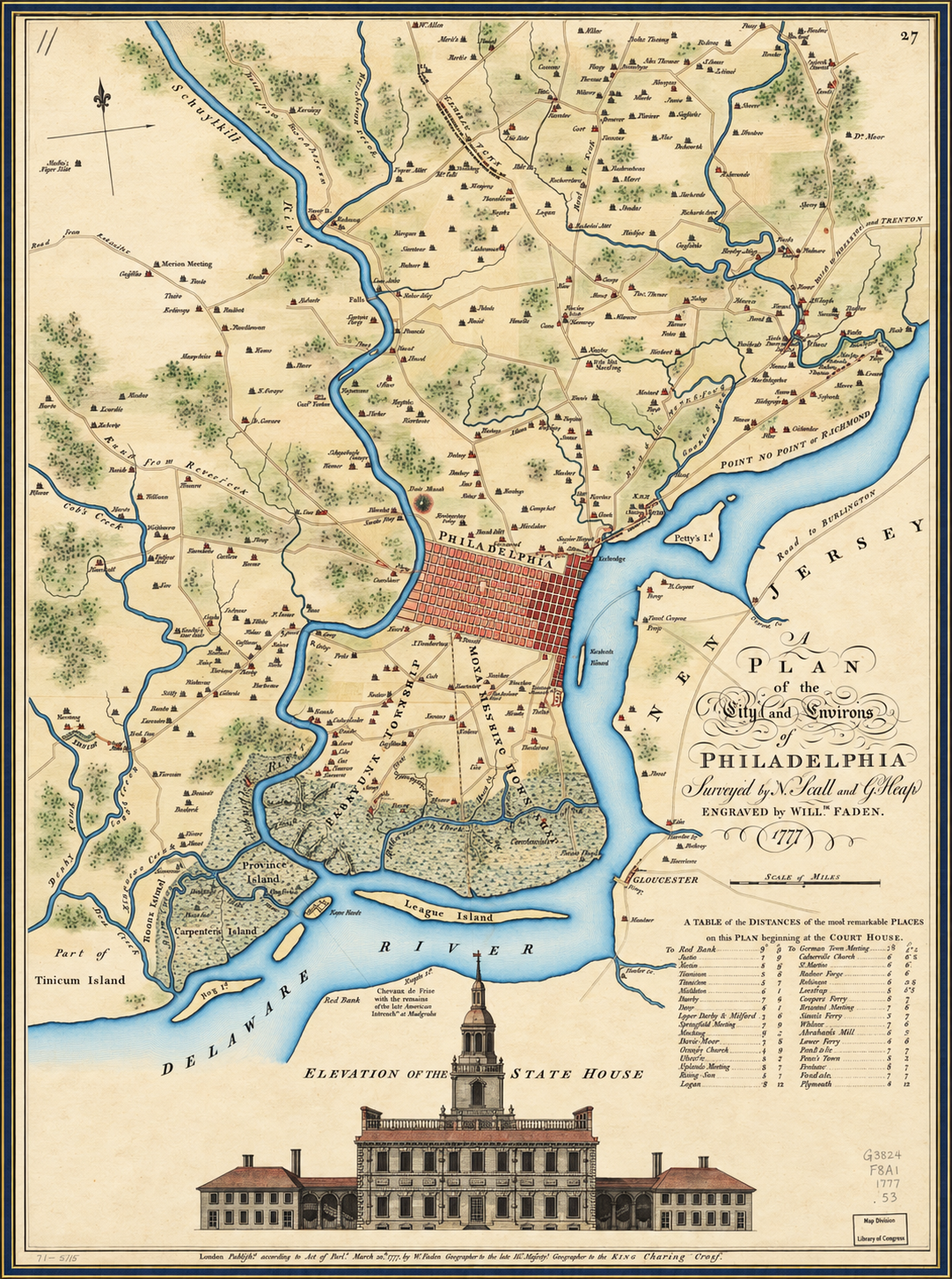
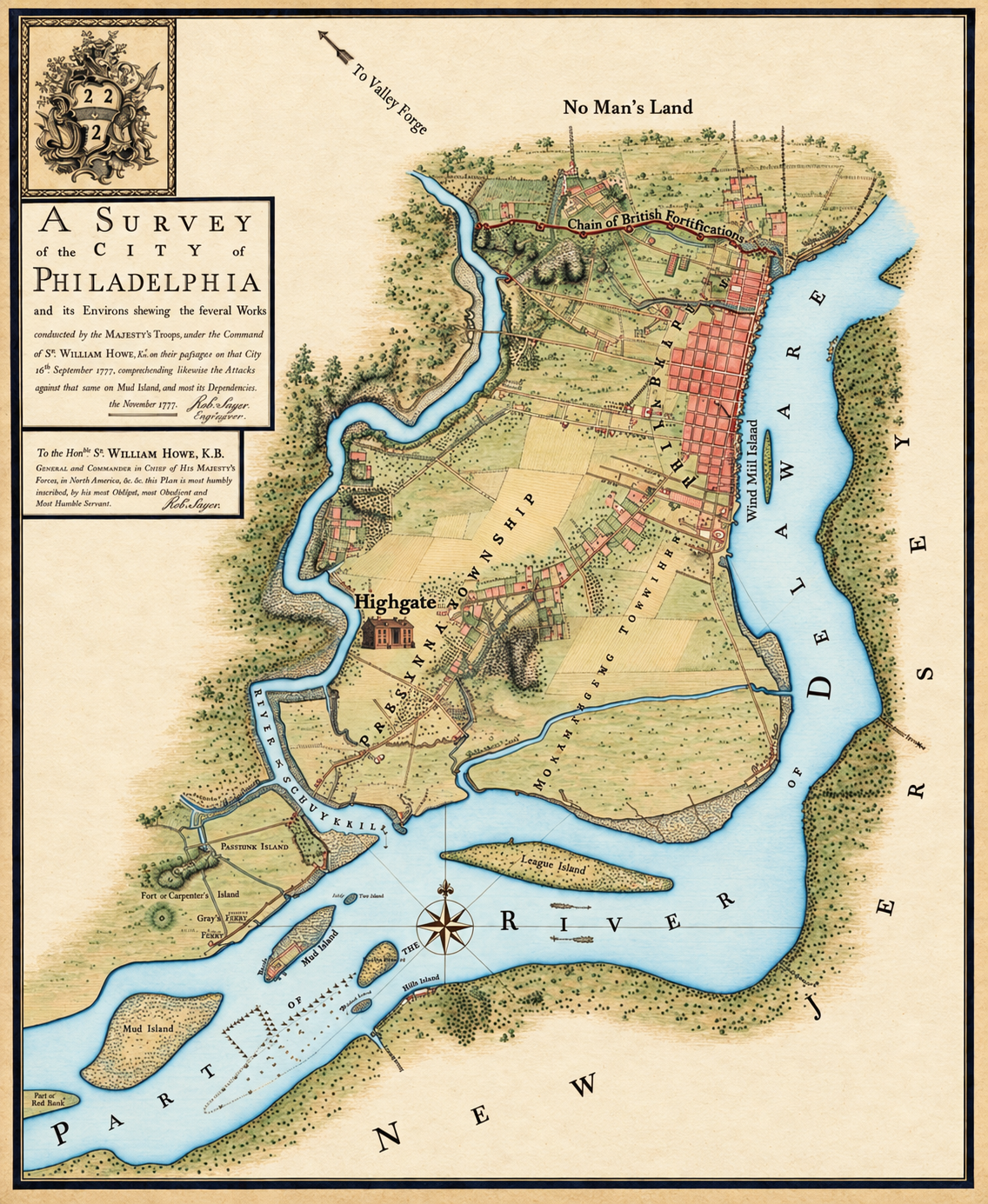
Philadelphia and Its Environs During the British Occupation
Major Battle Sites in the Northern Theater of War
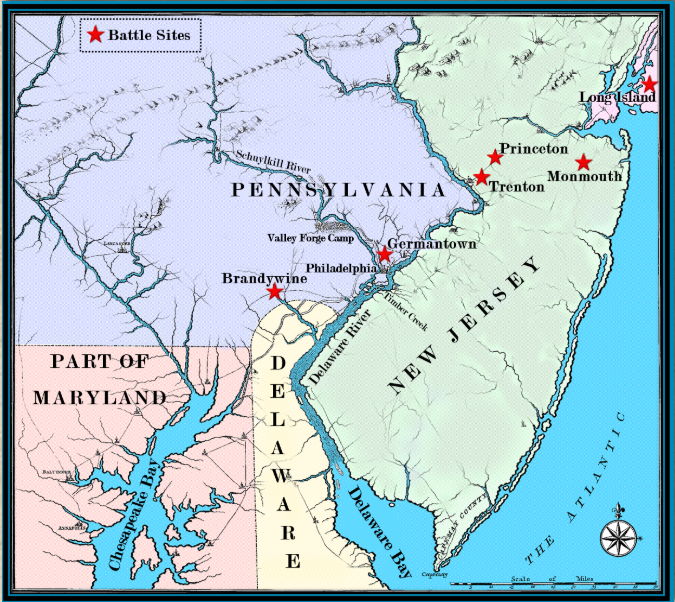
- Battle of Long Island, New YorkAug. 27, 1776
- Battle of Trenton, New JerseyDec. 26, 1776
- Battle of Princeton, New JerseyJan. 2, 1777
- Battle of Brandywine, PennsylvaniaSept. 11, 1777
- Battle of Germantown, PennsylvaniaOct. 4, 1777
- Battle of Monmouth, New JerseyJune 28, 1778