Afterword
A Spirit Tested, a Victory Secured
The Battle of Monmouth was the last major engagement fought in the northern colonies during the American War of Independence. While many historians consider it a draw, the “hot scratch” on the plains of New Jersey proved to be a turning point for the rebel cause. The spirit displayed that day sent a grim message to the British Parliament: the Continental Army had become a formidable, professional foe.
Yet, the true strength of the Revolution lay in the incomparable courage, fidelity, and resilience of America’s men-at-arms. From an assemblage of misfits, thieves, tradesmen, and highborn smugglers, a gentleman farmer from Virginia forged an army destined to change the world. They were men who, like Dalton Jameson, fought for a “Rightful Cause”—not just for a flag, but for the right to return to the fields, valleys, and villages they called home.
Following the stalemate at Monmouth, the conflict shifted southward, eventually culminating in the fall of 1781 at the small tobacco port of Yorktown, Virginia. There, besieged by allied American and French forces, General Charles Cornwallis conceded to George Washington’s demand of unconditional surrender. At two o’clock on the afternoon of Friday, October 19, 1781, six thousand redcoats marched out and threw down their arms in sullen defeat.
When the news reached London, Britain’s Prime Minister, Lord Frederick North, reportedly threw up his hands and cried, “Oh God! It is all over.”
For the soldiers of the Revolution, however, the “end” was a beginning. As the last British warships cleared New York Harbor two years later, men like Dalton and women like Alexandra turned their backs on the “gauntlet of groans” and the “lingering thrum of the battlefield.” They were the pioneers of a new era, trading the sword for the plowshare to build “roomy, if not grand” houses across a fledgling new nation.
No account of this struggle would be complete without honoring its unsung heroines—the “lioness” hearts who served in field hospitals and held the home front together. Their sacrifices were the quiet bedrock of the nation. They ensured that the “brand-new stars” born in the wake of the war would grow up in a land where the day truly belonged to them.
“With a heart full of love and gratitude, I now take leave of you. I most devoutly wish that your latter days may be as prosperous and happy, as your former ones have been glorious and honorable.”—George Washington’s Farewell to his Officers
Philadelphia in 1776
At the outbreak of the American War of Independence, Philadelphia was the largest English-speaking city in the world after London, boasting a population of some 40,000. Its picturesque cobblestone streets, laid out at right angles, expanded westward from extensive wharves along the Delaware River.
The cultural jewel of the Thirteen Colonies, Philadelphia's list of firsts in 18th-Century America impresses. These include the first public school, lending library, hospital, medical society, medical college, scientific institution, fire engine, volunteer fire company, lightning rod used for protection against fires, fire insurance company, first bell ever cast in America, first permanent theater house and company of stage players, first anti-slavery society, and the first treatise against slavery published in any part of the world.
During the war for independence, the city became a military objective of Major General William Howe, commander in chief of the British army in America. In the fall of 1777, at great cost to his army, Howe succeeded in capturing the seat of the rebel government. Benjamin Franklin, then on a diplomatic mission in Paris, took the news of Howe's victory in stride. His shrewd assessment has amused historians for centuries: “Sir, you mistake the matter. Howe hasn't taken Philadelphia; Philadelphia has taken Howe.”
Franklin was right. Howe occupied Philadelphia for the next nine months, spending much of that time in liquor-soaked indolence while General George Washington and his officers transformed the Continental Army at Valley Forge into an effective, disciplined fighting force.
Independence Hall
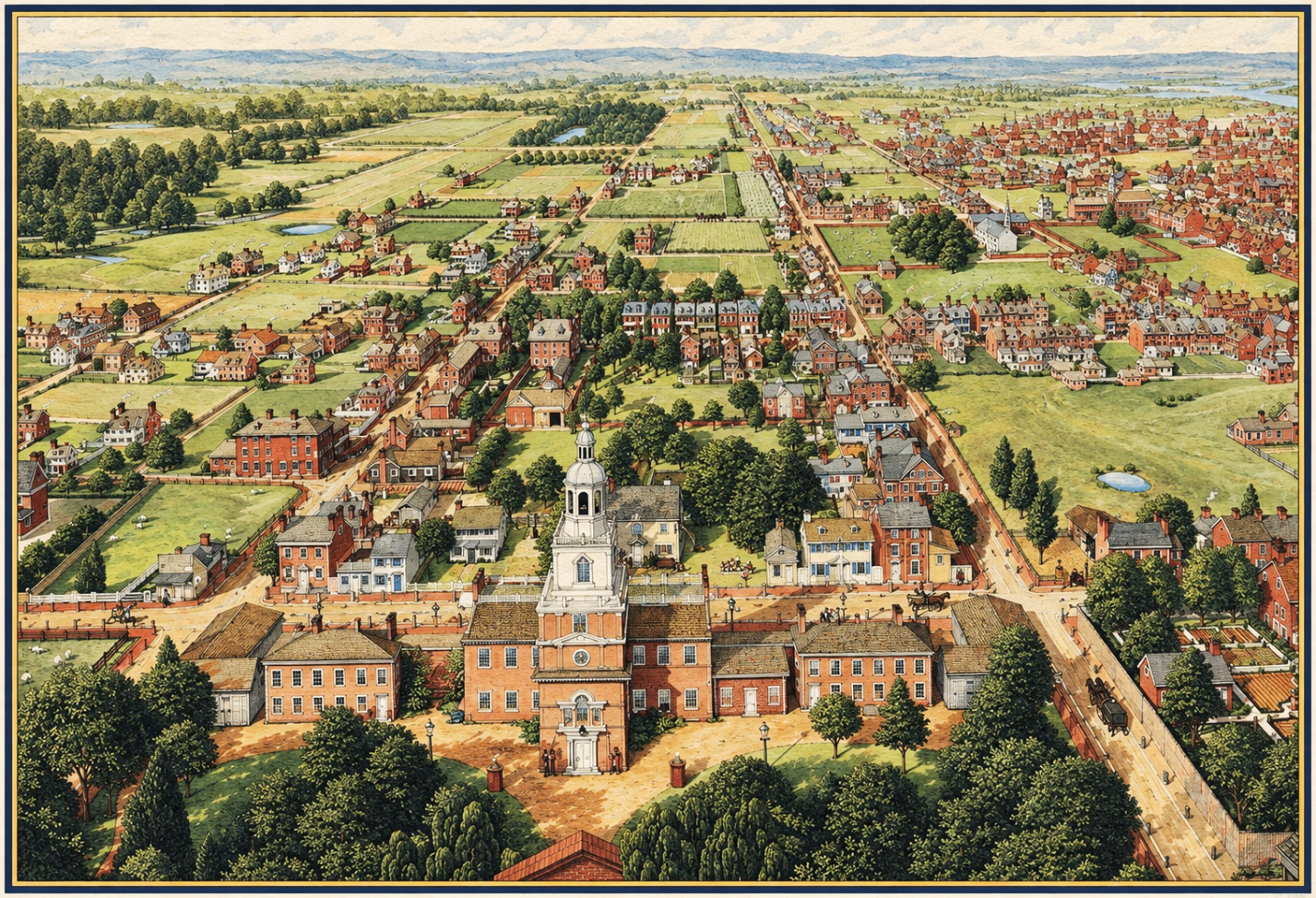
The Pennsylvania State House fronted on Chestnut Street between Fifth and Sixth streets. Known today as Independence Hall, this revered building was the seat of the rebel Congress through most of the American Revolution. The painting below by Philadelphia artist Paul MacWilliams, Pennsylvania State House in 1776, depicts a bird's-eye view from behind the State House looking north toward the highlands. Based on years of meticulous research, MacWilliams’ splendid rendering captures the life and landscape of the revolutionary city.
The Easburn Map
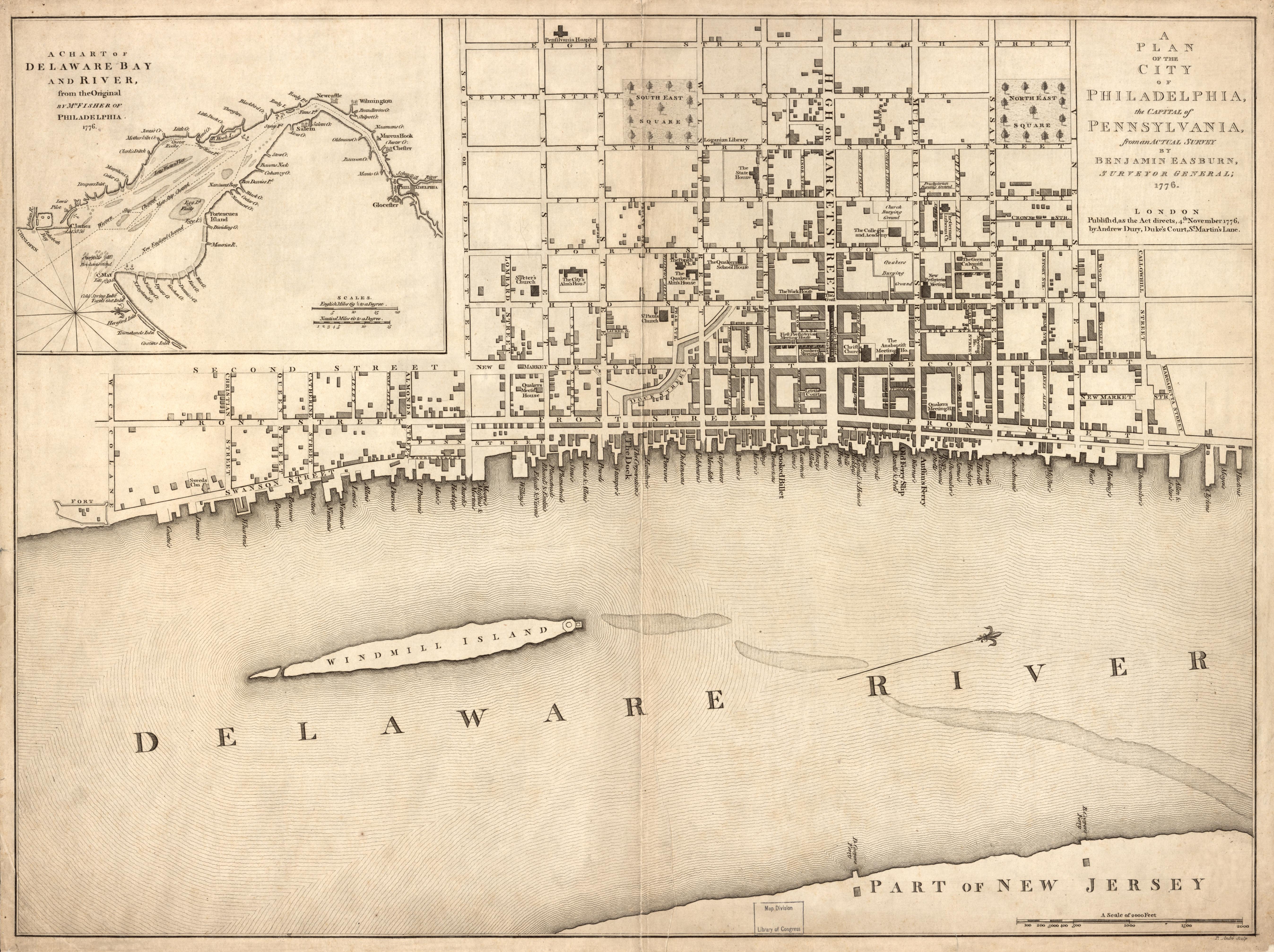
The Philadelphia street map presented here is part of a survey performed in 1776 by Benjamin Easburn, surveyor general of Pennsylvania. Oriented with the north toward the right, the map shows wharves, streets, houses, parks and cemeteries, as well as a library, college, jail, almshouse and hospital. It also indicates the locations of churches of a variety of denominations, including Roman Catholic, Lutheran, German Calvinist, Presbyterian, Moravian, and a Swedish church, along with several meeting houses and other institutions associated with the predominantly Quaker community.
The Faden Map
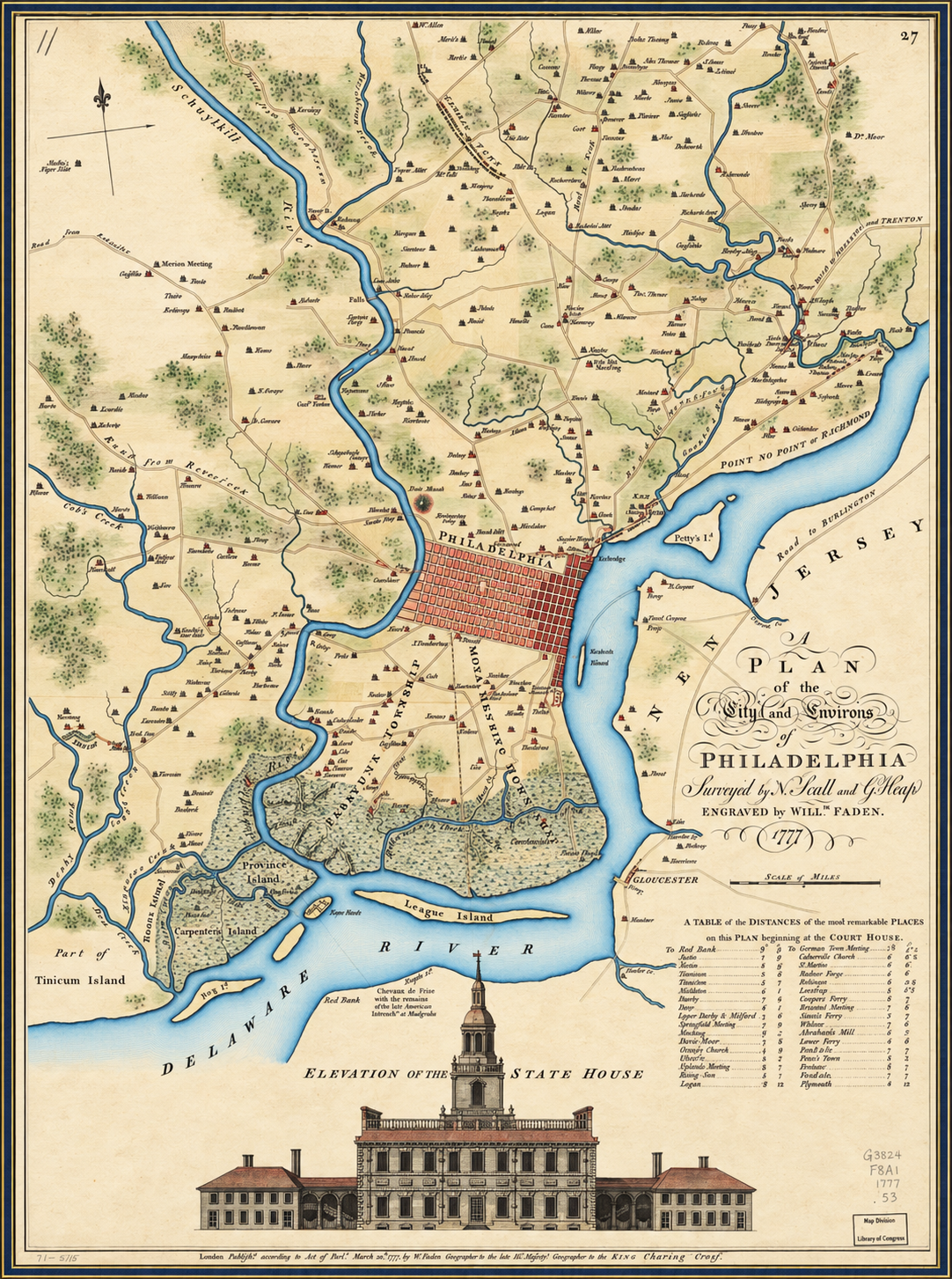
The map below was published in London in 1777 by William Faden. The dark shading outlines Philadelphia proper along the Delaware River waterfront. The lighter shading indicates the anticipated city expansion across a two-mile grid between the Delaware and Schuylkill rivers.
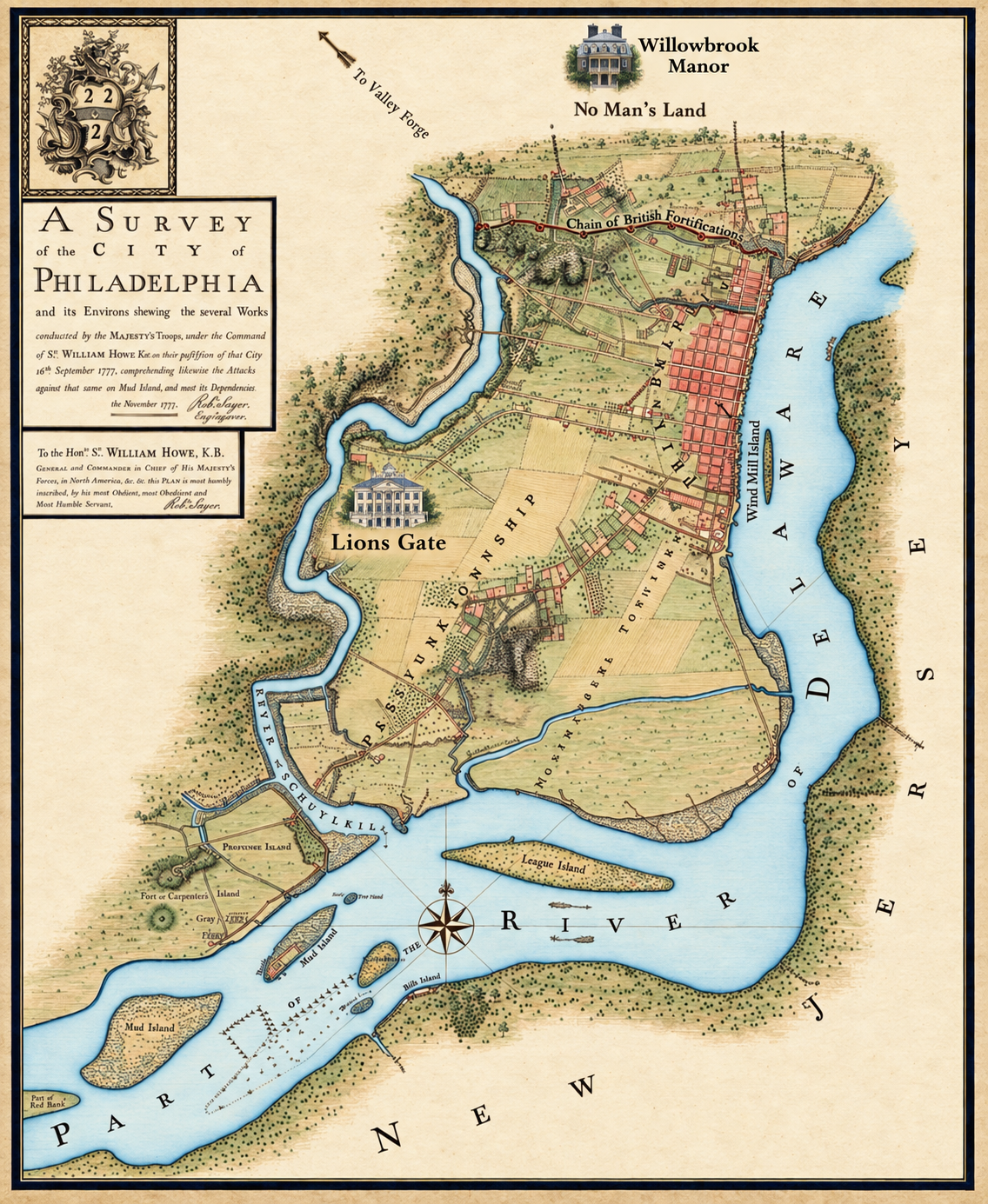
Philadelphia and Its Environs During the British Occupation
Major Battle Sites in the Northern Theater of War
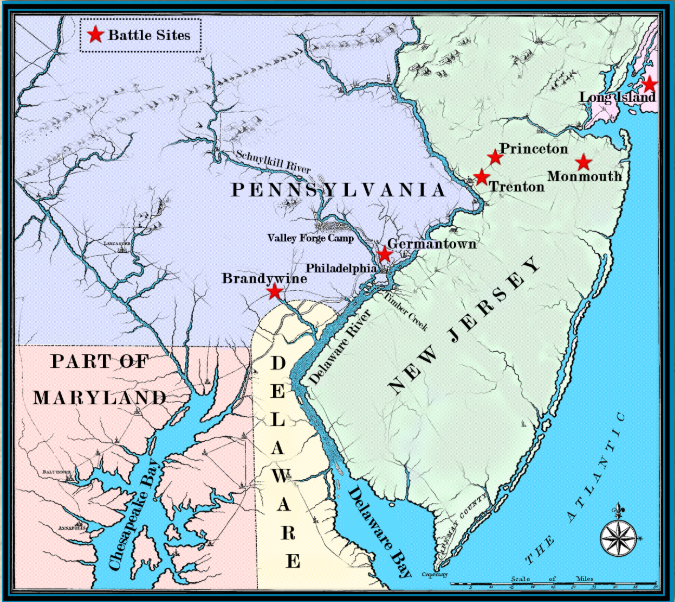
- Battle of Long Island, New YorkAug. 27, 1776
- Battle of Trenton, New JerseyDec. 26, 1776
- Battle of Princeton, New JerseyJan. 2, 1777
- Battle of Brandywine, PennsylvaniaSept. 11, 1777
- Battle of Germantown, PennsylvaniaOct. 4, 1777
- Battle of Monmouth, New JerseyJune 28, 1778